
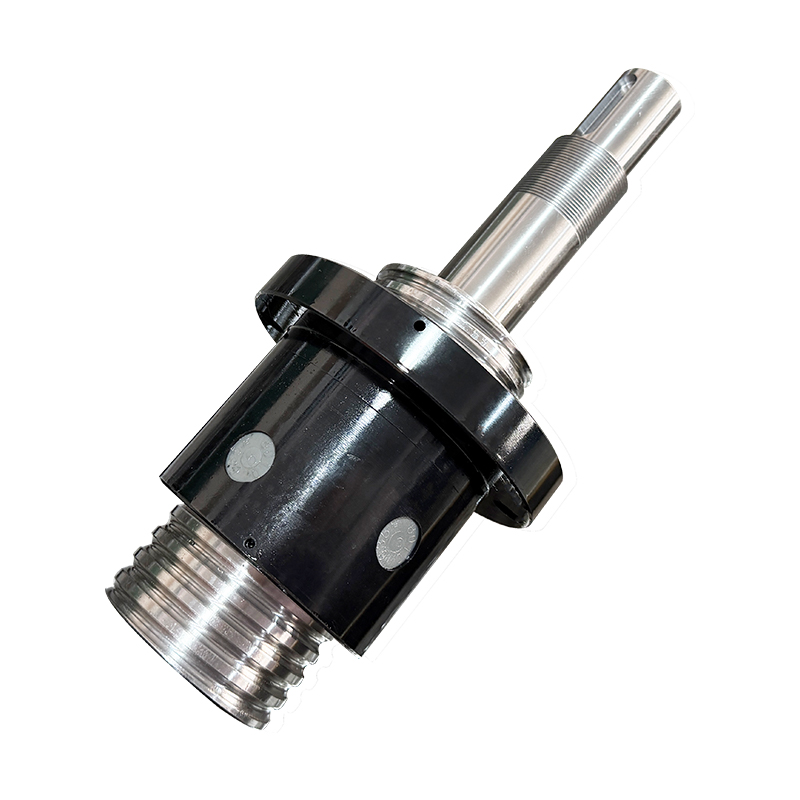
In precision mechanical transmission systems, ball screws are considered the "core lifeline," directly determining the positioning accuracy, operational stability, and service life of the equipment. Whether it's a CNC lathe, an automated production line, or a precision lifting platform, if the ball screw experiences problems such as vibration, jamming, or wear, it will not only lead to reduced processing accuracy and lower production efficiency, but in severe cases, it can also trigger cascading failures and cause significant economic losses.
Today, we will provide a complete solution for the three most common problems with ball screws—vibration, jamming, and wear—to help you quickly resolve these issues.
I. Vibration Faults: Identifying the Root Cause and Precisely Reducing Vibration
When a ball screw operates with noticeable vibration, accompanied by a "buzzing" noise, and even causing the machine body to resonate, this is a typical vibration fault. These problems are often related to installation, load, lubrication, or system matching, and require troubleshooting from the following perspectives:
1. Analysis of Core Causes
Insufficient installation accuracy: A concentricity deviation between the ball screw and motor shaft exceeding 0.05mm generates centrifugal force during rotation, causing periodic vibration; incorrect selection of support bearings, such as using deep groove ball bearings to bear axial force, leads to operational oscillation.
Dynamic load imbalance: An excessive slenderness ratio (e.g., a 20mm diameter ball screw with a length > 1200mm) reduces the critical speed, causing resonance; improper preload, either too tight (increasing friction and temperature rise) or too loose (leading to backlash), can induce vibration.
Lubrication and contamination issues: Deterioration of lubricating grease or the presence of impurities increases friction between the balls and raceways, generating vibration; seal failure allows abrasive particles to enter, further exacerbating the vibration.
System matching conflicts: High servo motor gain causes self-excited oscillation; loose couplings or insufficient torsional rigidity lead to excessive transmission lag angle and vibration.
2. Targeted Solutions
Calibrate installation accuracy: Use a laser alignment instrument to adjust the concentricity of the motor and ball screw, ensuring the deviation is ≤0.05mm; replace the support bearings with angular contact bearings to improve operational rigidity.
Optimize load and preload: Add intermediate supports to ball screws with excessive slenderness ratios to reduce the risk of resonance; adjust the preload to 15%-20% of the rated load to balance rigidity and friction losses.
Improve lubrication and protection: Replace with wear-resistant synthetic lubricating grease (such as SKF LGEP2), and remove impurities from the old grease; install labyrinth seals to prevent abrasive particles from entering and exacerbating friction-induced vibration.
Adjust system parameters: Reduce the servo motor position loop gain (recommended value 300-800) to eliminate self-excited oscillation; replace with a backlash-free diaphragm coupling and tighten the connecting parts to reduce transmission lag.
II. Sticking and Jamming Faults: Clearing Obstructions and Reducing Resistance for Smooth Transmission
When a ball screw operates with a "jerky" motion, or even fails to move smoothly, and manual rotation shows significantly increased resistance, this is a typical symptom of a sticking or jamming fault. The core causes are often foreign object intrusion, lubrication failure, or component deformation. Treatment should focus on "clearing obstructions, reducing resistance, and calibration."
1. Analysis of Core Causes
Foreign object intrusion and blockage: Seal failure, lubricant contamination, environmental dust penetration, or assembly residue can lead to foreign objects such as metal chips, dust, or adhesive particles entering the raceway. When the size of the foreign object exceeds the gap between the ball and the raceway (0.01-0.03mm), it directly jams the ball.
Lubrication failure: Failure to change grease regularly or improper grease selection leads to dry friction between the ball and the raceway, resulting in a significant increase in resistance; cutting fluid mixed into the lubricating grease forms a "abrasive lubricant," exacerbating the risk of sticking.
Component deformation and wear: Screw bending leads to excessive straightness deviation, generating additional radial force during operation; ball wear, raceway scratches, or damage to the circulation components hinder smooth transmission.
2. Targeted Treatment Solutions
Thorough cleaning and obstruction removal: Disassemble the ball screw nut assembly and use an ultrasonic cleaning machine with a neutral cleaning agent to remove foreign objects and old grease from the raceway; for raceway scratches <0.01mm, use polishing paste for manual repair; for scratches >0.01mm, use laser cladding technology to fill the scratches.
Optimize the lubrication system: Replace with suitable synthetic lubricating grease, which has 40% better wear resistance than traditional lithium-based grease; use an automatic lubrication system for timed and quantitative oil supply to avoid lubrication contamination.
Calibration and component replacement: Use a dial indicator to check the straightness of the screw; slight bending can be corrected by pressure straightening, while severe deformation requires replacement; if the balls or circulation components are worn, it is recommended to replace the entire ball screw nut assembly to avoid accuracy mismatch caused by replacing only the balls. Upgraded Sealing Protection: Replace the double-lip dust seal (gap ≤0.05mm), and install a telescopic protective cover at the end of the ball screw to prevent chips and coolant from entering, thus avoiding foreign object jamming from the source.
III. Wear and Tear Failures: Graded Repair for Extended Lifespan
After prolonged use, ball screws may experience wear problems such as raceway pitting, scratches, and spalling, or ball wear and screw bending, directly leading to decreased positioning accuracy and increased backlash error. Wear treatment requires a graded approach based on the degree of damage to avoid over-repair or insufficient repair.
1. Core Cause Analysis
Lack of lubrication maintenance: Long-term lack of grease replacement or insufficient lubrication leads to dry friction between the balls and raceway, exacerbating wear; contaminated grease generates abrasive particles, increasing the wear rate by 200%.
Improper installation and load: Excessive coaxiality deviation and eccentric load cause localized stress concentration on the screw, accelerating wear; frequent overloading or impact loads cause raceway fatigue spalling.
Environmental and material issues: Humid environments lead to screw corrosion, accelerating wear; poor material quality or insufficient manufacturing precision results in insufficient raceway surface hardness, shortening the service life.
2. Graded Treatment Solutions
Mild wear (raceway scratches < 0.01mm, no spalling): Clean the raceway, then manually polish, replace with new grease and ensure even filling; check and adjust the installation coaxiality to eliminate additional loads and prevent further wear.
Moderate wear (raceway scratches 0.01-0.05mm, localized pitting): Repair using nano-grinding + chrome plating technology. First, plate the raceway surface with 0.03mm thick hard chrome to improve wear resistance, then grind to the original precision level; replace all balls, controlling the repair density to over 8% to ensure even contact.
Severe wear (raceway spalling area > 10%, screw bending > 0.1mm): For low-precision equipment, straightening + grinding repair can be attempted; for high-precision equipment, it is recommended to directly replace the ball screw and nut assembly; when replacing, prioritize high-precision products of the same model to ensure compatibility with the equipment.
IV. Key Prevention: Proactive Maintenance to Reduce Failure Rate by 90%
Compared to reactive maintenance, proactive prevention is more efficient in extending the lifespan of ball screws and reducing the risk of failure. Based on industry best practices, we recommend establishing a closed-loop management system of "daily inspection + regular maintenance," focusing on the following four points:
1. Standardized lubrication management
2. Regular accuracy calibration
3. Enhanced protective measures
4. Establishment of maintenance records
Summary
The problems of vibration, jamming, and wear in ball screws may seem complex, but their root causes are mainly concentrated in three core dimensions: "installation accuracy, lubrication and maintenance, and load matching." To solve these problems, simply identify the cause based on the observed symptoms, and then take targeted measures such as calibration, cleaning, repair, or replacement to quickly restore equipment performance.
Please Read On, Stay Posted, Subscribe, And We Welcome You To Tell Us What You Think
Get Directions

Copyright @ 2024 Nanjing Chunxin Automation Equipment Co., Ltd., Limited. All Rights Reserved.
 Network Supported